DCS Analytics
Quality control · Windows desktop

Two quality-control worlds,
one application.

Levey-Jennings charting with automatic Westgard evaluation for the clinical laboratory. Batch tracking, specification limits and process capability for manufacturing. The same software, switched by mode — because the statistics underneath are the same statistics.

€499 one-time · perpetual licence · per installation
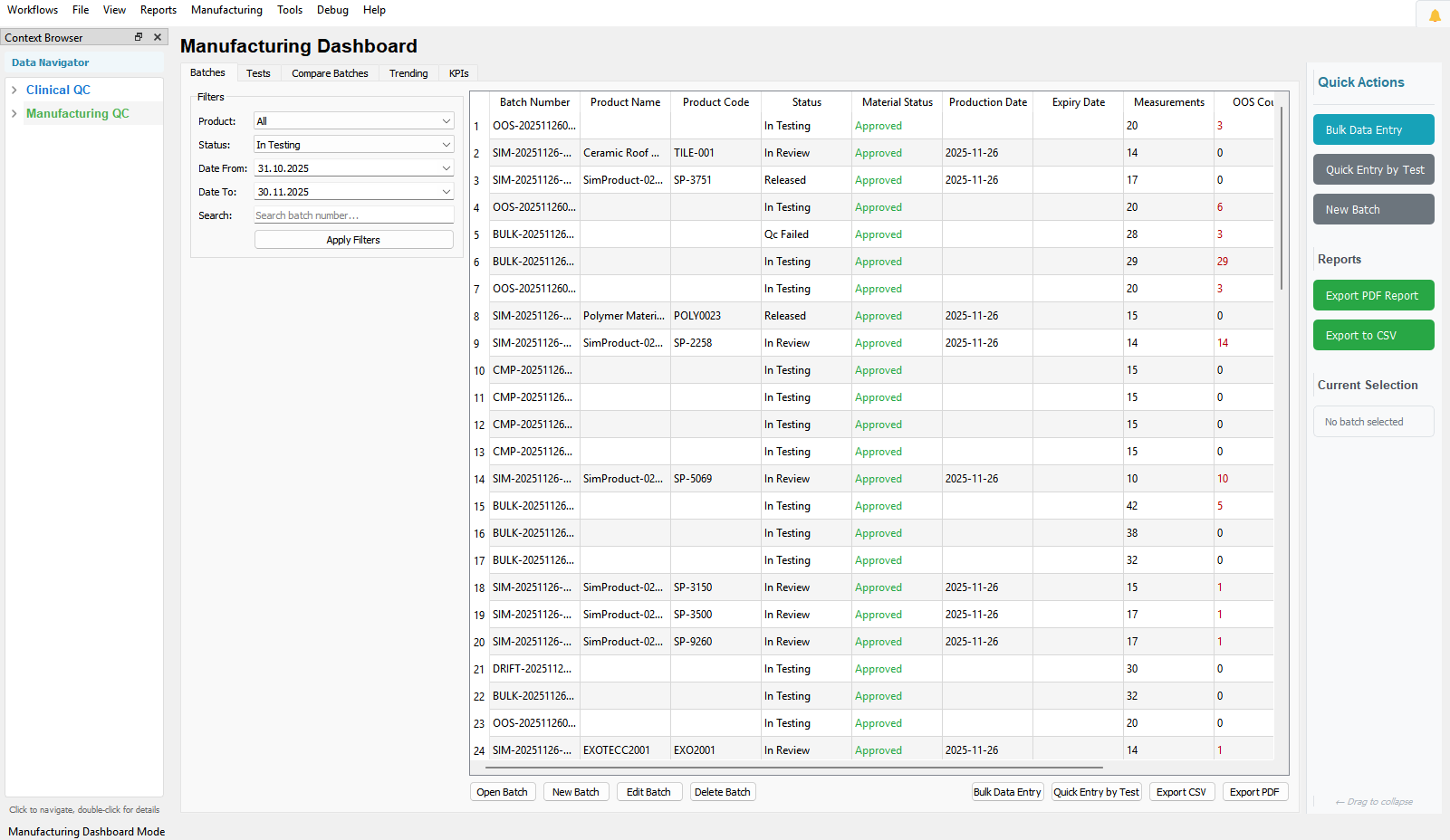
QC Cards Suite manufacturing dashboard showing batch table with status, material status and out-of-specification counts
Clinical QC mode

Westgard rules applied every time, not when someone remembers.

A control point gets entered and the rules run. Not at review, not at month end — immediately, on every level, on every entry.

Levey-Jennings, multi-level

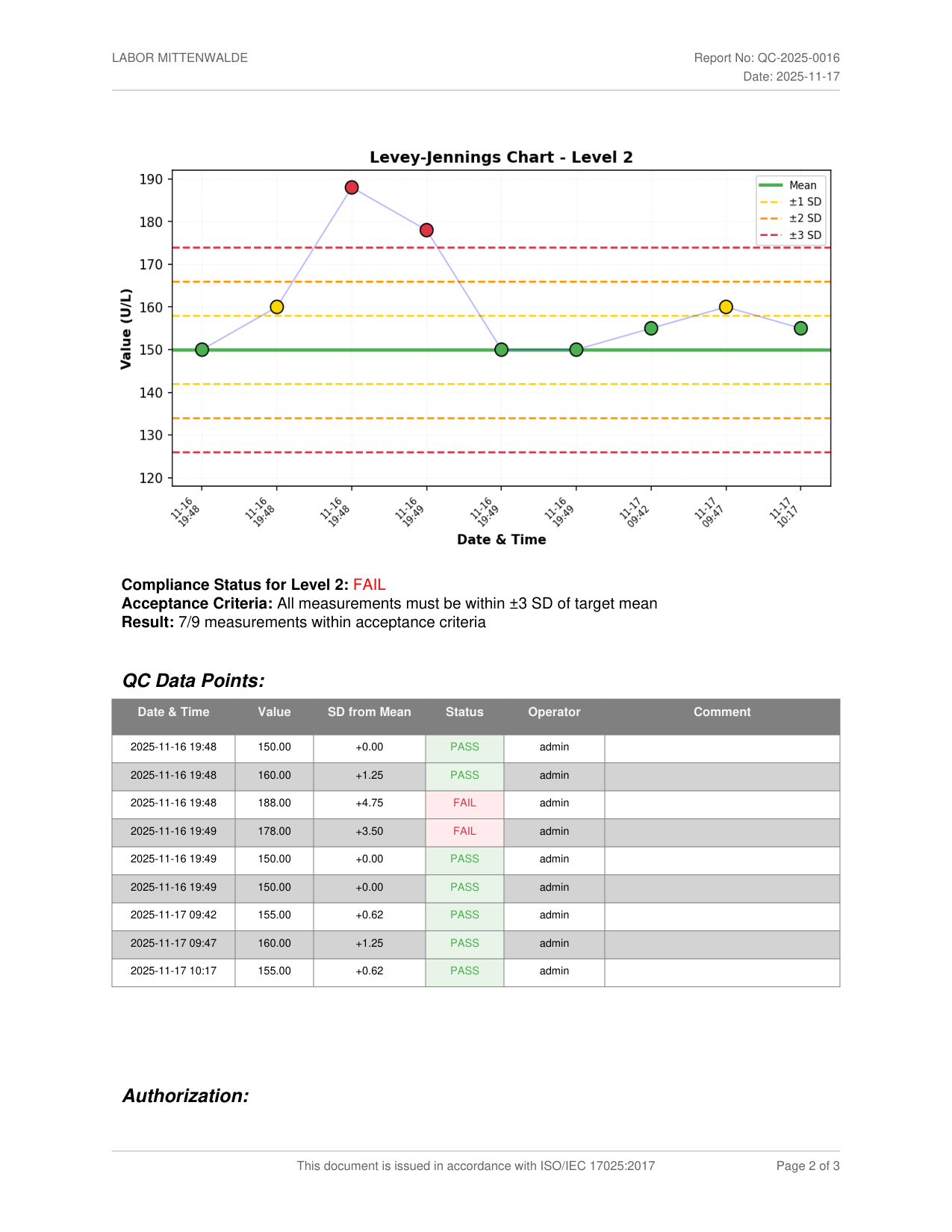
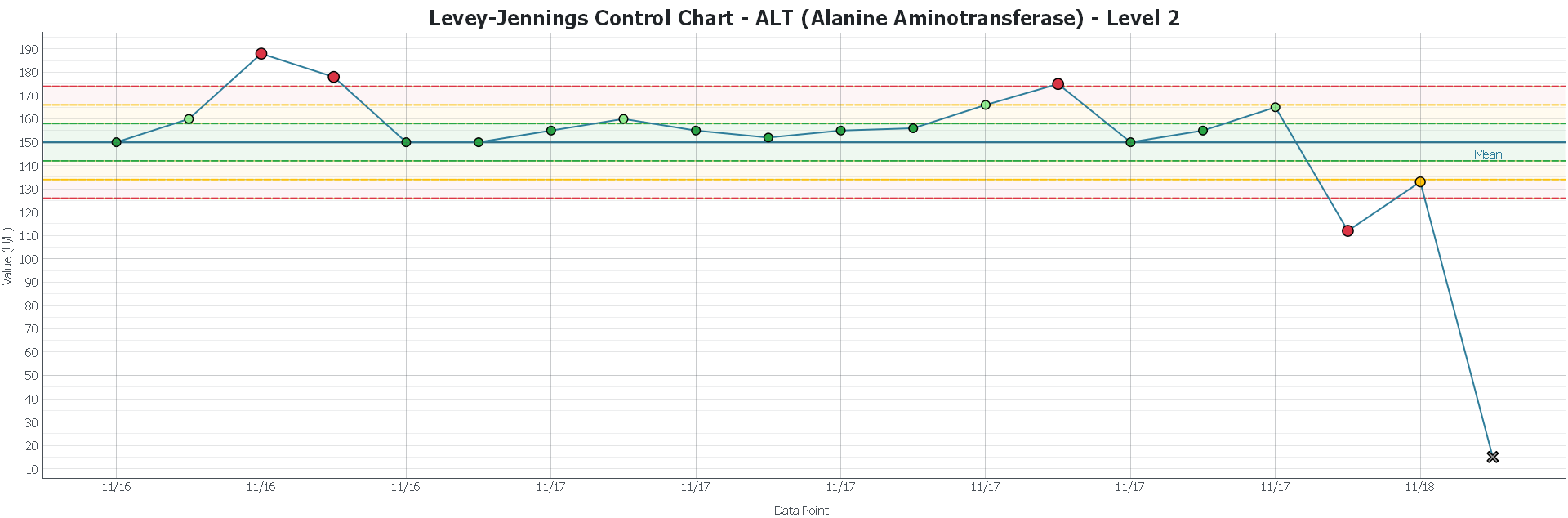
Up to three QC levels per item, each with target mean, standard deviation, lot number and expiry. Control limits drawn at mean and ±1SD, ±2SD, ±3SD, with points coloured by deviation and tooltips carrying the measurement detail.

  • Template library of pre-configured clinical tests, or build a QC item from scratch
  • Date-range filtering and interactive inspection
  • Lot number and expiration tracking per level
Levey-Jennings control chart for ALT Level 2 with mean, 1SD, 2SD and 3SD limits and points coloured by deviation

Six Westgard rules, evaluated automatically

The rules are implemented as written, including the multi-level and sequential ones that are genuinely tedious to check by eye across a run.

  • 1:2s — single point beyond 2SD (warning)
  • 1:3s — single point beyond 3SD (rejection)
  • 2:2s — two consecutive points beyond 2SD
  • R:4s — range exceeding 4SD between levels
  • 4:1s — four consecutive points beyond 1SD
  • 10x — ten consecutive points on the same side of the mean
Monthly QC report page showing the Levey-Jennings chart, compliance status and a per-measurement pass/fail table with operator attribution
Manufacturing mode

Batch quality control, from goods-in to release.

A four-tab dashboard covering batches, tests, comparison and trending, with a KPI view over the top.

B

Batches

Searchable tree of every batch, filtered by product, status or date. Statuses run In Progress, In Testing, Completed, Released, Rejected. Batch detail opens the full measurement set with a live SPC chart and specification-compliance indicators.

P

Products & tests

Product catalogue with families for grouping, SKU and code tracking, and per-test specification limits — LSL, USL and target — that drive the out-of-specification flagging.

C

Batch comparison

Put batches side by side on the same test to see whether a shift is a batch problem or a process problem. Multi-batch comparison with exportable output.

K

Trending & capability

Trend a test across batches over time, with Cpk process-capability analysis and a KPI dashboard summarising release rates and out-of-specification counts.

Lot validation as a defined procedure

New reagent or material lots go through a structured validation: start a validation, enter the runs, calculate the statistics, and then approve or reject it as an explicit, recorded decision with the person attached.

  • Statistics computed across the validation runs
  • Approve-and-sign or reject, with reason retained
  • Exportable lot-validation report
Getting data in, getting reports out

Designed around the person doing the eleven o'clock entry.

Bulk data entry

Enter a full run in one dialog rather than one dialog per measurement.

Quick entry by test

Enter the same test across several items or levels in sequence.

CSV import

Bring in historical or instrument-exported data in bulk, with validation on import.

Daily & monthly reports

Per-analyte daily and monthly PDF reports, single level or all levels.

Violation reports

Westgard violations over a chosen date range, as a PDF for review or filing.

Audit trail

Full audit log with operator attribution and timestamps, exportable to CSV.

It speaks your industry's language

A clinical laboratory says analyte, level and control. A manufacturing plant says test, batch and specification. QC Cards Suite carries a terminology layer that relabels the interface to match the profile you are working in — so the software does not force one industry's vocabulary onto the other.

  • Switchable terminology profiles, clinical and manufacturing
  • Essential View to reduce the interface to routine daily operations
  • Guided first-run wizard for initial setup
Manufacturing dashboard showing the batch table with status, material status and out-of-specification counts
Specifications

Technical details

PlatformWindows 10 and 11, 64-bit. Desktop application, installed locally.
InstallationInstaller with quick-start guide and full user manual included.
ConnectivityFully offline. No cloud service, no account, no external dependency.
ModesClinical QC and Manufacturing QC, switchable from the Mode menu.
Clinical statisticsMean, SD, CV%, ±1/2/3SD control limits, six Westgard rules, multi-level tracking
Manufacturing statisticsSpecification limits (LSL/USL), out-of-specification detection, SPC charting, Cpk process capability
Data entrySingle point, bulk entry, quick entry by test, CSV import. Operator identification and comments on every entry.
Data storageLocal database with full measurement history.
ReportingDaily, monthly, violation, lot-validation and batch-comparison reports as PDF; CSV export throughout.
ComplianceBuilt to support ISO 17025 documentation practice, with audit trail and operator attribution.
DocumentationUser manual and quick-start guide supplied as PDF with the licence.
LicenceOne-time purchase, perpetual, per installation.
Questions

Frequently asked

What is QC Cards Suite?

Desktop quality-control software with two modes. Clinical QC gives Levey-Jennings charting with automatic Westgard evaluation across up to three control levels. Manufacturing mode gives batch tracking, specification-limit monitoring, Cpk process capability and structured lot validation.

Which Westgard rules are evaluated?

Six, automatically on every entry: 1:2s, 1:3s, 2:2s, R:4s, 4:1s and 10x — including the multi-level and sequential rules that are tedious to check by eye across a run.

Can one licence cover both clinical and manufacturing work?

Yes. Both modes are included in the €499 licence, switched from the Mode menu. A terminology layer relabels the interface so a clinical lab sees analyte, level and control while a manufacturing site sees test, batch and specification.

Does it need an internet connection?

No. It runs entirely offline with a local database — no cloud service, no account, no external dependency. Suitable for validated and isolated environments.

Is it a subscription?

No. One-time purchase of €499 for a perpetual licence per installation. No recurring fee, no maintenance contract.

What reports can it produce?

Daily and monthly QC reports per analyte, Westgard violation reports over a date range, lot-validation reports and batch comparison reports — all as PDF, with CSV export throughout including the audit trail.

QC Cards Suite — €499, one-time

Perpetual licence per installation, both modes included. Online checkout is being set up and is pending payment-provider approval; until it is live, write to us and we will arrange invoicing, delivery and the licence key directly.